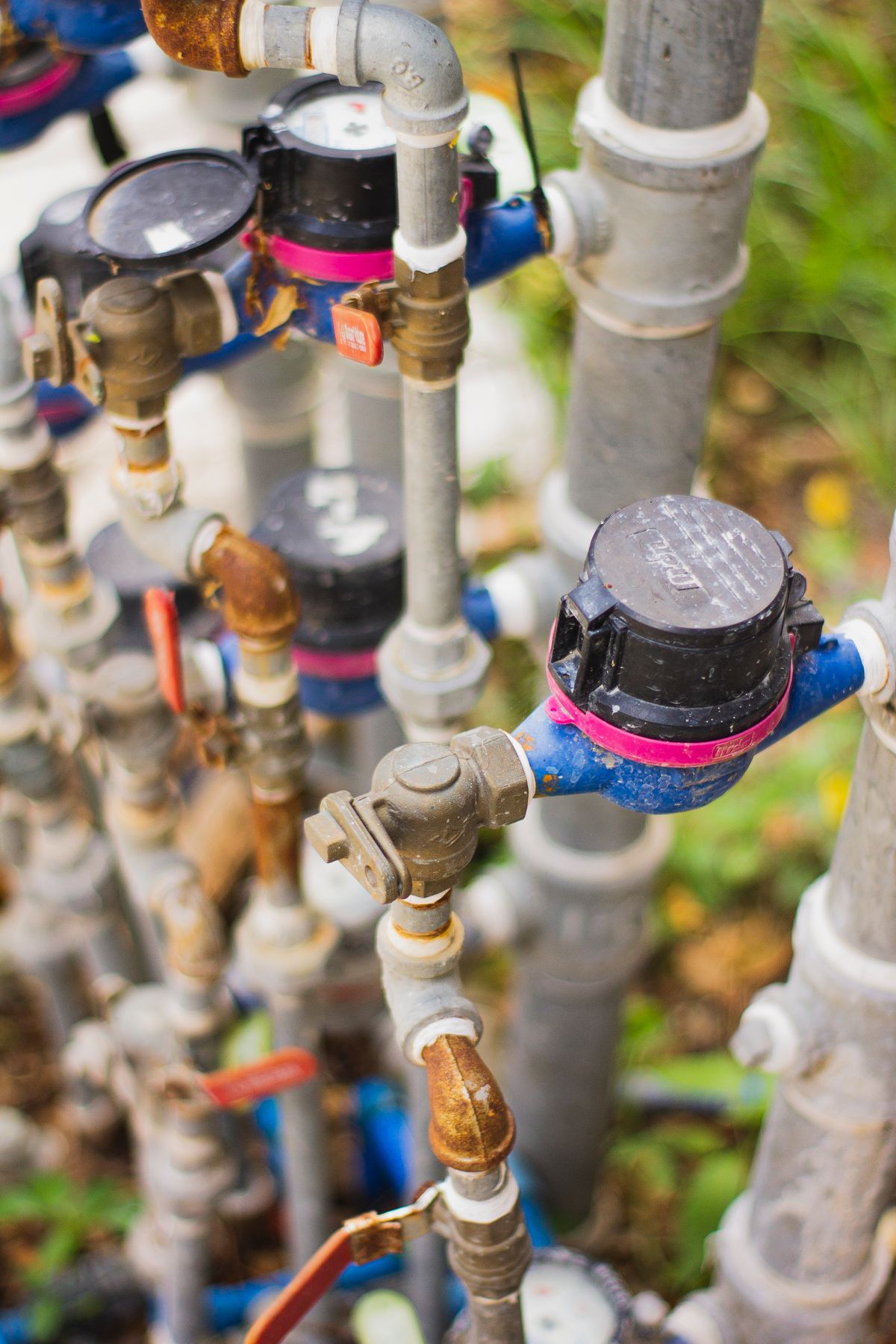
Finding and reading the meter
In most Nevada neighborhoods the meter sits in a box in the ground near the front curb or the side of the property, with a lid you can lift with a screwdriver or a hook. Some sit by the garage wall. If you share a wall or live in a complex, the meter may be in a common area.
Lift the lid carefully. Watch for insects and wasps, and do not put a hand where you cannot see. A flashlight helps. If the meter is wet or dirty, wipe the glass.
The face usually has an odometer-style row of digits and a small triangle, star or dial that spins at the lowest flows. That small indicator is the leak detector. It turns when even a trickle is moving.
Take a photo of the face before you start. You will compare it with a second photo later.
The routine, step by step
- Turn off every tap, the dishwasher, the washing machine and the ice maker. Make sure no toilet is refilling and the water heater is not in a fill cycle.
- Look at the leak indicator for two full minutes. If it is still, there is no continuous flow right now. If it is turning, something is using or losing water.
- If it is turning, close the main shutoff at the house and look again. If the indicator stops, the water is going somewhere inside the house side of the line. If it keeps turning, the leak is between the meter and the shutoff.
- Reopen the main. Now go to the irrigation controller and set it to off, or close the irrigation valve. Look again at the indicator. If it stops, the yard is the culprit.
- If you have a pool with an automatic fill, close the fill valve and look again.
Record each result. The sequence of results tells you where to look next.
Reading the results
The routine produces a short list of outcomes, each with a different meaning.
- Still with everything off
- No continuous flow at the moment. If the bill is high, look at habits, irrigation schedules and season.
- Moving, stops with the main closed
- The leak is on the house side of the shutoff. Next: is it a fixture, a yard line or the slab?
- Moving, stops with irrigation off
- The leak is in the irrigation system. That is not a slab leak.
- Moving, stops with pool fill closed
- The pool fill is the cause. That is not a slab leak.
- Moving, stops only with the main closed, irrigation and pool excluded
- The leak is likely in the house lines. In a slab home, that includes under the floor.
- Moving even with the main closed
- The leak is before the shutoff, between meter and house. Tell the person who answers.
Special cases to watch for
Some meters tick forward at intervals because a toilet, a softener or an ice maker is topping up. If the movement comes in short bursts every few minutes, look for a toilet that refills. A drop of food coloring in each tank, left for fifteen minutes, will show a leaky flapper.
If the indicator crawls very slowly, with a full turn taking minutes, the loss is small. A small leak is still a leak, but it is less urgent than a fast spinner.
Some homes have a pressure regulator or a thermal expansion tank, which can cause small, occasional movements as pressure equalises. A leak is steady; an expansion event comes and goes.
If your meter is a newer electronic type, the display may show a flow indicator or alert. The readings are the same idea, and the display may show the last interval of flow.
The overnight version
If the two-minute check is still but you suspect a slow leak, try the overnight check. Take a photo of the meter face just before bed. Make sure nothing is on. In the morning, before anyone uses water, take another.
If the readings differ, water moved overnight. The difference gives a rough measure of how much. Do the same with irrigation off, ideally on a night when the controller is not scheduled.
Some people find it easier to do this over a weekend. The point is to capture a long window with no deliberate use.
Nevada notes
Nevada homes often have irrigation systems on timers, plus pools, which makes the exclusion steps important. A stuck valve can run for hours. If your irrigation controller is on a schedule, do the check outside those times or turn it off first.
In HOA communities, the common-area irrigation may run on a separate meter or may share one. If your unit is part of an attached complex, check whether the meter you are reading is yours. A management contact can tell you.
Boom-era homes with copper under the slab are the typical case where a still-quiet meter becomes a moving one over the course of a year. See boom-era home slab leaks.
In northern Nevada, meter boxes can freeze over in winter, so a meter that is hard to read in January may be easier in the afternoon. Never force a frozen lid.
After the check
If the check points at the house lines, the next step is isolation of the hot and cold sides, followed by locating. Slab leak detection describes the visit.
If it points at the yard, the technician cannot help with irrigation or pool repair, but the information is useful, and you will know not to pursue a slab leak. Pool, drip system or slab covers this.
If the meter is still, nothing is leaking now. Keep an eye on it, and if the bill remains high, see high water bill, hidden leak.
Making the check easier and more accurate
A few small things make the meter check more reliable. None needs special equipment.
Use your phone. Photograph the meter face before and after. The photos let you compare digits precisely, and they give the technician something to look at.
Use a flashlight if the box is dark, and a soft cloth to wipe the glass. A little condensation inside the lid is normal. If the glass is cloudy inside, mention it to the technician.
Write down the time with each reading. If you are taking readings over a night, note when the last water was used. A single flush at 11pm can explain a small change.
Check the units. Many meters read in cubic feet or gallons, and the last digit may be a fraction. Know which digit is which before comparing.
If you have a smart meter or an app from the provider, it may show hourly use. A flat line overnight with a steady nonzero value is a strong signal. Look at it as well.
If you do not trust the result, repeat it. Leaks do not stop on their own, but an appliance cycling can confuse a single reading.
Keep your notes. Write down what you did, in order, and what the meter did at each step. If you call a crew, read them out.
If you cannot do the check, say so. The crew can do it on arrival, and it only takes a few minutes.
A one-page record to keep
After the check, write the results on one page and keep it. The date, the time, the meter reading, and what the dial did at each step. Add the irrigation and pool results, and any observation about sounds or warm spots.
If you call a crew, the page is your script. If you have the check done again after a repair, it is your comparison.
It also helps with a billing question or a conversation with a landlord, a property manager or an HOA, because it shows what was tested and when.
Where this comes up in Nevada
The meter check works the same way everywhere, though some homes have a well instead of a meter. Local pages that cover the homes and conditions around this topic include Boulder City, Fernley, Elko and Moapa Valley.
The pages note where meters and wells differ by area. Other towns are on the areas page.
Common questions
What does the little triangle on the meter mean?
+
It is the low-flow indicator. It turns whenever water passes through, even at a trickle.
Can I do the check if I share a meter?
+
Only if you know which meter is yours. Ask your management contact.
Do I need to turn off the water heater?
+
No. Just make sure it is not refilling after a recent use.
How long should I watch the meter?
+
Two minutes for a quick check. Overnight for a slow leak.
What if the meter moves only a little?
+
A slow leak is still a leak. Call and mention the rate you saw.
Is it safe to lift the meter lid?
+
Use a hook or screwdriver, wear gloves if you like, and watch for insects.
What if I cannot find the meter?
+
It may be near the curb, the side of the property or in a common area. Management or a neighbor may know.
What if the meter was moving once and is now still?
+
Intermittent flows come from toilets, softeners and irrigation. Check again at different times.
Related reading: the sound of running water and slab leak repair.